
How to Use Monk Fruit Instead of Sugar — The Complete Swap Guide

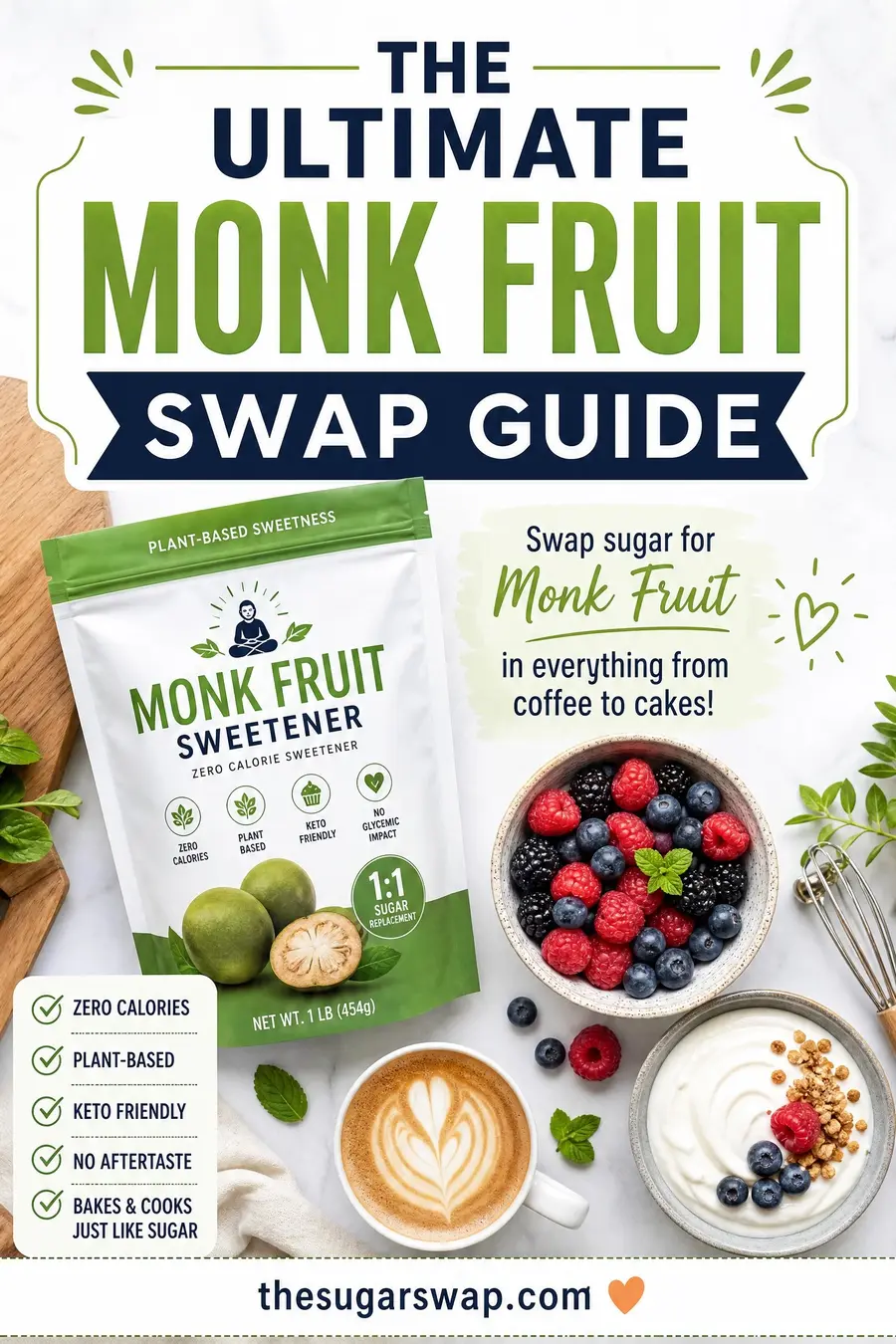
The most common question I get after someone discovers monk fruit is: okay, but how much do I use? Because monk fruit is not sugar. It does not behave like sugar in every situation. And if you just swap it one-for-one in a recipe that calls for a cup of white sugar, you will end up with something approximately three times sweeter than you intended and a slightly confused expression on your face.
I have done the testing so you do not have to. Here is the practical guide to using monk fruit instead of sugar — across every situation I have encountered in three years of low sugar cooking.
"Monk fruit is not a one-size-fits-all swap. It's a toolkit. Once you know which tool to reach for, it becomes second nature."
First: Which Form of Monk Fruit Are You Using?
This matters before anything else, because the ratios are completely different depending on the form.
- Pure liquid drops — extremely concentrated. A few drops replaces a teaspoon of sugar. Start with 3 drops per teaspoon and adjust.
- Granulated blend (monk fruit + erythritol) — designed to be a 1:1 sugar replacement. Measures like sugar. Best for baking.
- Pure granulated monk fruit (no erythritol) — much sweeter than a blend. Use approximately ¼ the amount you would use of sugar.
- Powdered blend — same ratio as granulated blend (1:1), but finer. Better for frostings and no-bake fillings.
When a recipe on this site calls for monk fruit, it means a granulated monk fruit-erythritol blend unless stated otherwise. This is the most practical and widely available form for everyday cooking.
The Swap by Situation
Best form: Liquid drops or granulated blend.
Liquid drops dissolve instantly in hot drinks — add them after brewing, stir once, done. Granulated blend also dissolves well in hot liquids, though it takes a quick stir. Both work perfectly.
The taste difference from sugar is barely noticeable in coffee. In a plain herbal tea it can be slightly more apparent — start with less than you think you need.
Best form: Liquid drops.
Granulated sweeteners dissolve slowly in cold liquids and can leave a slightly gritty texture. Liquid drops dissolve instantly regardless of temperature — which makes them ideal for the Avocado Lime Smoothie, cold brew, and any iced drink.
Best form: Liquid drops or granulated blend.
Monk fruit works brilliantly in sauces — the Sugar Free Teriyaki Sauce and No Sugar Added Marinara both use it. In a warm sauce, the granulated blend dissolves cleanly. In a cold dressing, use liquid drops to avoid any graininess.
Best form: Granulated blend or liquid drops.
A sprinkle of granulated monk fruit blend over plain Greek yogurt with berries is the easiest low sugar breakfast upgrade I know. It dissolves into the yogurt within about 30 seconds of stirring. Liquid drops work just as well if that is what you have.
Best form: Granulated blend (monk fruit + erythritol).
This is where it gets slightly more technical. The granulated blend measures 1:1 with sugar, which makes it easy. But sugar does more than sweeten in baking — it adds moisture, helps browning, and creates structure. Monk fruit does not replicate all of these properties.
In practice: most cakes and muffins come out well. Cookies tend to spread less and be slightly paler. See the full guide to baking with monk fruit for recipe-specific advice.
The Master Swap Chart
| Situation | Best Form | Ratio to Sugar |
|---|---|---|
| Hot coffee or tea | Liquid drops | 3–4 drops per tsp |
| Cold drinks & smoothies | Liquid drops | 3–5 drops per tsp |
| Sauces (warm) | Granulated blend | 1:1 |
| Salad dressings (cold) | Liquid drops | 3–4 drops per tsp |
| Yogurt & oats | Granulated blend | ½:1 (half as much) |
| Baking (cakes, muffins) | Granulated blend | 1:1 |
| Frosting & cheesecake filling | Powdered blend | 1:1 |
| No-bake bars & energy balls | Granulated or powdered blend | 1:1 |
What Monk Fruit Cannot Do
In the spirit of honest swapping — here is what monk fruit does not replicate:
- Caramelisation. Pure monk fruit and most blends will not go golden brown in the oven. For recipes where browning matters — BBQ sauce, crème brûlée, sticky toffee — you will need to combine it with a small amount of coconut sugar or use allulose if you can find it.
- Volume in certain baked goods. A cup of granulated blend provides the same physical volume as a cup of sugar, which helps. But because it behaves differently in the oven, very delicate recipes like meringues and soufflés can be unpredictable.
- Preservation. Sugar acts as a preservative in jams and conserves. Monk fruit does not — so sugar free ketchup and similar recipes need to be stored in the fridge and used within a shorter window.
In the US and UK, monk fruit sweeteners are available in most health food stores, Whole Foods, and online. Outside Europe (where it is not yet approved as a novel food additive), iHerb ships internationally and carries a wide range including Lakanto, NOW Foods, and Whole Earth — all reliable brands. Look for products with just two ingredients: monk fruit extract and erythritol.
My Everyday Monk Fruit Setup
I keep two forms of monk fruit in my kitchen at all times. Liquid drops by the coffee machine — three drops in my morning coffee, done, every day without thinking. A bag of granulated blend in the baking cupboard for everything else. That covers probably 95% of what I cook.
If you are just starting out, buy the granulated blend first. It is the most versatile, the easiest to get right, and the most similar to using sugar. Once you are comfortable with it, add liquid drops for drinks and you have everything you need.