
The Best Allulose Substitutes (And When to Use Each One)

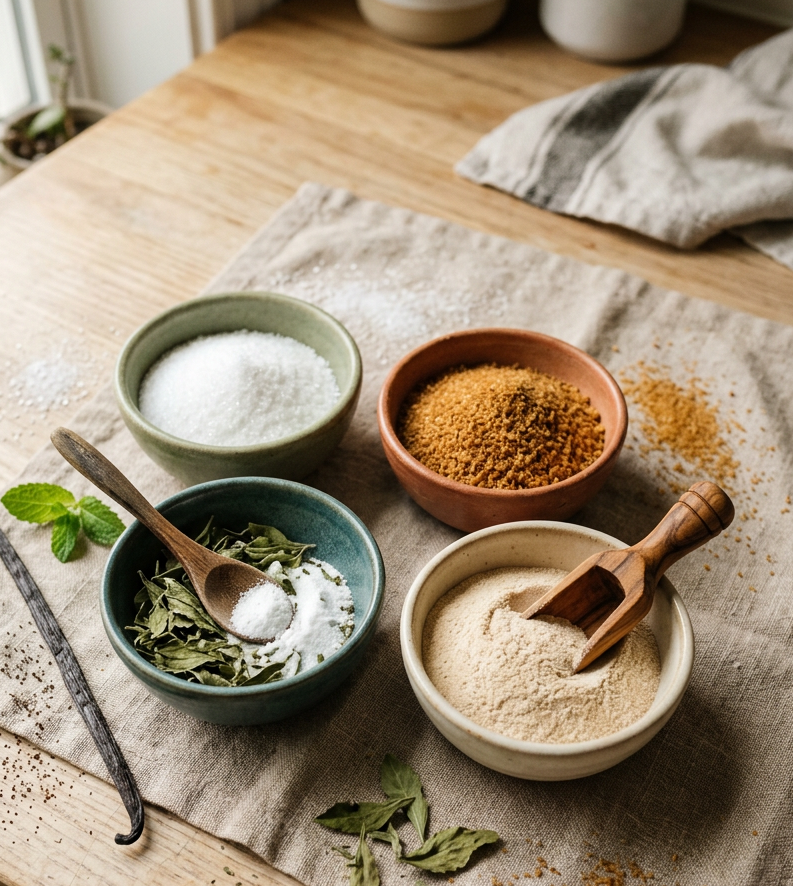
Allulose is, in my completely biased opinion, the best sugar substitute for baking. It browns. It caramelises. It creates a crackly brownie top and a chewy cookie centre. It does the things that sugar does in the oven, without doing the things that sugar does to your blood glucose.
The problem is that allulose can be difficult to find — particularly here in Europe — and it is often more expensive than other sweeteners. So when you can't get it, or when the budget doesn't stretch, or when you're halfway through a recipe and have just discovered the jar is empty: what do you actually use instead?
I've tested most of the alternatives extensively. Here's what I've found.
First — what makes allulose special?
Before we get into substitutes, it helps to understand what allulose actually does that other sweeteners don't. If you want the full story, the allulose deep-dive covers it in detail. The short version:
- It's about 70% as sweet as regular sugar
- It browns and caramelises like real sugar — critical for baking
- It keeps baked goods moist and fudgy rather than dry and crumbly
- It dissolves smoothly — no gritty texture
- It contributes almost zero calories and doesn't spike blood glucose
Any substitute needs to replicate as many of these properties as possible. No single one does all of them perfectly, which is why the best substitute depends on what you're making.
The substitutes — and when they work
| Substitute | Best for | Browns? | Aftertaste? |
|---|---|---|---|
| Monk fruit | Drinks, no-bake, general sweetening | ✗ No | ✓ None |
| Erythritol | Baking (with adjustments) | ✗ Limited | ⚠ Cooling |
| Monk fruit + erythritol blend | Baking, most uses | ⚠ Some | ✓ Minimal |
| Xylitol | Baking, confectionery | ⚠ Some | ✓ Mild |
| Stevia | Drinks, small quantities | ✗ No | ⚠ Bitter |
Monk fruit — the best everyday substitute
If you only keep one sweetener in your kitchen, make it monk fruit. It has zero calories, no aftertaste, and dissolves beautifully in cold and warm liquids. For drinks, dressings, no-bake recipes, and anything that doesn't need to go in the oven, monk fruit is a direct and excellent swap for allulose.
The limitation: it doesn't brown or caramelise. This matters enormously in baking — without browning, cookies come out pale and oddly textureless, and brownies lack their characteristic crackly top. For a recipe like the No-Sugar-Added Brownies or the Sugar-Free Chocolate Chip Cookies, monk fruit alone won't give you the same result.
Use monk fruit instead of allulose when: you're sweetening drinks, making no-bake recipes, or making anything where texture and browning don't matter.
Erythritol — the baking substitute with caveats
Erythritol is widely available, affordable, and about 70% as sweet as sugar — the same ratio as allulose, which makes it mathematically the most straightforward swap. It also has near-zero calories and a minimal effect on blood glucose.
The caveats: erythritol has a noticeable cooling sensation in the mouth, particularly in larger quantities. And it doesn't brown or caramelise the way allulose does — baked goods made with erythritol tend to come out paler and slightly crisper rather than golden and chewy.
Use erythritol instead of allulose when: allulose is unavailable and you're baking something where colour matters less than structure — like a cheesecake or a mousse. Use same quantity as allulose.
Monk fruit + erythritol blend — the practical compromise
Most commercial "monk fruit sweetener" products are actually a blend of monk fruit extract and erythritol, because pure monk fruit is very concentrated and difficult to measure accurately. These blends are what you'll find in most supermarkets and health food shops.
They're a reasonable all-purpose substitute. The erythritol provides bulk, the monk fruit provides sweetness without bitterness, and together they produce a more balanced result than either alone. For baking, expect slightly less browning and a slightly firmer texture than allulose.
Monk fruit for cold things and drinks. Monk fruit + erythritol blend for general baking. Allulose when you specifically need browning, caramelisation, or a fudgy texture. If allulose is unavailable, accept that the result will be slightly different and adjust expectations accordingly.
What doesn't work as a substitute
Stevia alone in baking — the bitter aftertaste becomes pronounced at high temperatures and in larger quantities. Fine for a cup of tea. Not ideal for a batch of cookies.
Coconut sugar — it does brown nicely, but it is still sugar. It has a lower glycaemic index than white sugar but it's not a low-sugar option. If you're reducing sugar for blood glucose reasons, coconut sugar doesn't help.
Honey or maple syrup — again, still sugar. Natural, yes. Low sugar, no.
The recipes that specifically need allulose
For most recipes on this site, a good monk fruit blend will work well as an allulose substitute. But there are a few where allulose is genuinely difficult to replace and the result will be noticeably different with any alternative:
- No-Sugar-Added Brownies — the crackly top requires allulose's caramelisation
- Sugar-Free Chocolate Chip Cookies — the golden edges and chewy centre come from allulose
- Sugar-Free Lemon Pie — the lemon curd needs allulose's smooth texture
For everything else — the Chia Tiramisu, the Peanut Butter Oat Cups, the Strawberry Popsicles — monk fruit works perfectly.
For a complete overview of all the sweeteners used on this site and when to use each one, the Swap Guide has the full breakdown.
Sources
- FDA: High-Intensity Sweeteners — fda.gov
- Harvard T.H. Chan: The Nutrition Source — Sugar Substitutes — hsph.harvard.edu
- MSU: Sugar and Sweetener Common Questions — cris.msu.edu